....are Brent and Jan LeBaron?!?! And why are so many people looking for them?
I get dozens of visits a day from people all over the world -- Canada, Spain, Australia, Japan -- who are Googling "Brent and Jan LeBaron." I randomly posted their excellent photos of Mt. St. Helens a few months back (a friend emailed them to me, but I don't know anything about who they are) and they have been far and away the most visited posts on Ish River Itinerate. So, my curiosity is piqued. If you are a Brent and Jan LeBaron Googler, leave a comment that will help me to decode this worldwide phenomenon!
Brent and Jan LeBaron
29 July 2006


16 June 2006
Tim McNulty's North Cascadian poems, reviewed
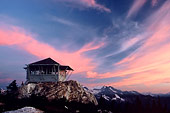
Through High Still Air: A Season at Sourdough Mountain
By Tim McNulty
Pleasure Boat Studio, 2005, $9
www.pbstudio.com
"The dry summer of 2003 saw wildfires sweep through the forests of the mountain West," writes Tim McNulty in the introduction to his latest chapbook of poems, Through High Still Air. "By August, a number of lightning-strike fires were smoldering in the deep mountain wilderness of Washington's North Cascades National Park. Four of them fell within sight of Sourdough Mountain Lookout."
McNulty explains how, after the park service decided to reactivate the historic lookout, he "jumped at the opportunity." It was a serendipitous decision: the summer of 2003 marked the 50th anniversary of poet Gary Snyder's tenure at Sourdough, a moment in time immortalized in Snyder's book Riprap, Jack Kerouac's Desolation Angels and John Suiter's Poets on the Peaks. Having one of the Pacific Northwest's finest contemporary nature poets atop Sourdough during this auspicious season was bound to inspire something special. Through High Still Air is McNulty's record of his mountaintop residency, and is appropriately dedicated to Snyder, "poet and lookout, fifty years down the trail."
In the too-brief 24 pages that follow, McNulty gives readers a chronicle of weather ("high winds up the Skagit/ pile dark-bottomed clouds/ against peaks and snowfields" and "taste of raincloud moving past,/ streams and rivers/ beginning again"), buddhistic meditations, a litany of the fire lookout's daily duties, field notes and observations on the behavior of wildfire ("I've never seen the utter transformation that is wildfire…this is raw presence, wild and unencumbered”). In McNulty's plainspoken summoning of North Cascadian elements -- heather and hemlock, Skagit gneiss and shadow, mountain ash and mist -- details accumulate until the effect is like an invocation, a heartfelt prayer to this particular corner of the planet.
Wildlife too regularly appears in these pages, including a three-point buck, a Swainson's hawk ("fierce, streamlined missile with wildly rippling feathers"), a short-tailed weasel, grasshoppers, a Townsend's warbler ("a gift from Costa Rican forests"), and spiraling sharp-shinned hawks ("poised, compact and gracefully alert"). McNulty observant poems even take notice of the animals that *aren't* there, like the "delicate tracks of/ small deer,/ nimble handprints of raccoons" or the footprints of black bears on the bottom of a tarn in his exquisite journal entry entitled "August 24, 'Three Bear Tarn'."
Poet Howard Nemerov once explained that "A poem is an act of attentiveness." Mary Oliver furthered this theory by confessing "This is the first, wildest, and wisest thing I know: that the soul exists, and that it is built entirely out of attentiveness." McNulty shared both of these quotes with me during an Institute poetry workshop in 2002, and Through High Still Air is testament to his abiding belief in the power of focused attention, intricate details and deep respect for the natural world.
Reviewed by Christian Martin. Photo by Todd Burley.
Tim McNulty teaches "Wild Poetics" -- a field course exploring the connections between nature, wilderness and poetic expression – June 23-25 at the North Cascades Environmental Learning Center, fittingly at the base of Sourdough Mountain. Information and registration at www.ncascades.org or 360-856-5700 x209.
[Tim McNulty]
[North Cascades]
[Fire Lookouts]
25 May 2006
TROJAN DOWN
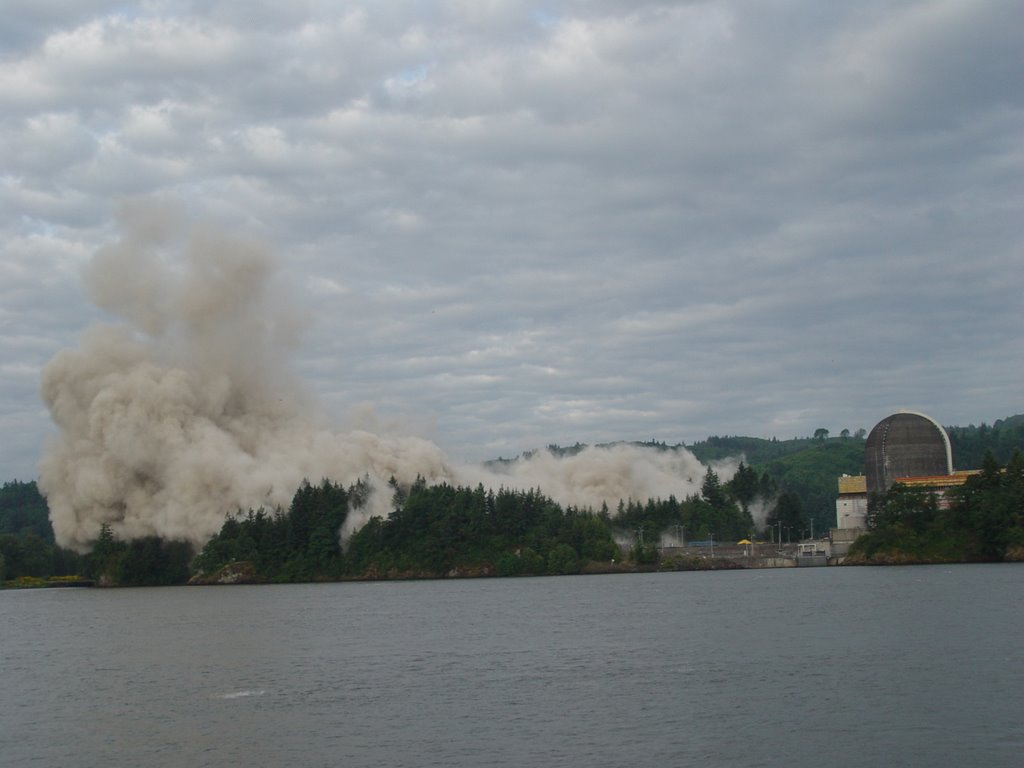
A friend of mine was in Kalama, WA last weekend for the implosion of the Trojan cooling tower. She gave me this report: "We were directly across the river from the tower. They shot off an initial round just to scare the birds out before the real action began, then a quick series of huge blasts and the thing dropped to the ground. The entire event could not have lasted more than five seconds. A moment later, as the dust was still settling, a sea lion popped its head out of the Columbia and looked around to see what all the fuss was about." She also took these awesome photos...


There are quite a few more photos, like the one below, here and the Seattle Times and The Columbian both have stories covering the big blow-up.

trojan


There are quite a few more photos, like the one below, here and the Seattle Times and The Columbian both have stories covering the big blow-up.

trojan
24 April 2006
Lost and Found Fotos: Mount St. Helens II

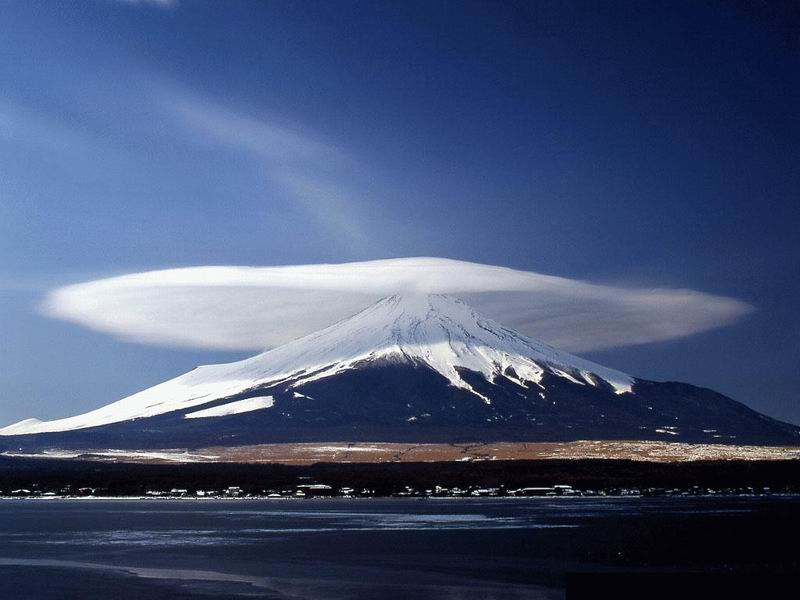
“Here is something not many of us get to see, unless you live near there - Mt. St. Helens at sunrise.
Mt. St.. Helens continues to spew ash, while it is forming a lava dome in the crater and still having minor tremors. Here in this sunrise shot, she appears to be blowing smoke rings (and anything so benign is welcomed, given recent history).
What forms the "smoke rings" is the air flowing over the mountain getting pushed up higher as it goes up and over the top. The moisture content and initial temperature are just right so that the moisture condenses from a vapor to small particles at the higher altitude. When the moving air moves past the peak and comes down again, the particles evaporate back to an invisible vapor.
The two "pancakes" describe that there are two layers of air for which this is happening, thus making this awesome picture possible.”
Photo and text by Brent and Jan LeBaron (I got it forwarded this stuff forwarded to me via email, and don't know the LeBarons personally...)
mt st helens
19 April 2006
18 April 2006
Tulips from Hell
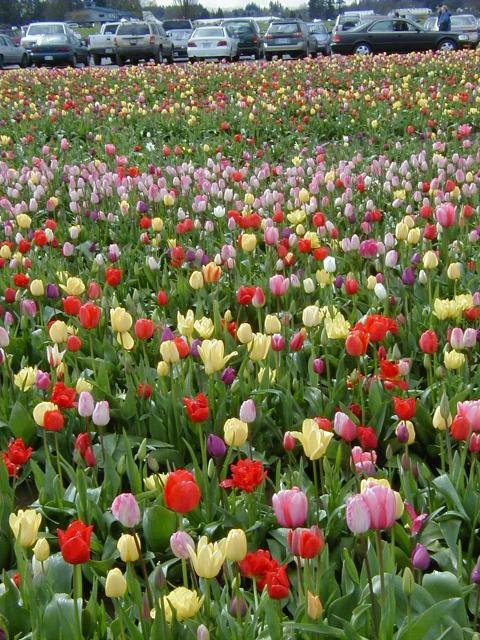
Another fine column from the Seattle Times' nutty Trail Mixer, Ron Judd, this time poking some well-deserved fun at the Skagit Valley Tulip Festival: "Too many gapers. Too many strollers spewing forth from too many mini-vans. Too many bike weenies with too many carbon-fiber pedal sets that would feed too many entire villages of starving orphans in too many Pakistans. You get the picture. Seeing the tulips is a fantastic, memorable experience. But it's sort of like viewing the Shroud of Turin: Once you've seen it, well, you've seen it, and the urge doesn't resurface until you are reincarnated as someone's great aunt from Hoboken."
Find the rest of Judd's column here.
16 April 2006
April Has Turned Cold
April has turned cold.
The evening light fades through the clouds.
A string of geese call me out
to sing a farewell, and
I wish them luck as they go from Ish River,
away out over the ocean,
long long sweeps of rippling wings
bound for Siberia.
Their wild song they take with them,
and leave some behind.
They leave enough so
I don't have to leave home any more.

--Robert Sund, from Poems from Ish River Country
Shoemaker & Hoard, 2004
robert sund
poetry
The evening light fades through the clouds.
A string of geese call me out
to sing a farewell, and
I wish them luck as they go from Ish River,
away out over the ocean,
long long sweeps of rippling wings
bound for Siberia.
Their wild song they take with them,
and leave some behind.
They leave enough so
I don't have to leave home any more.
--Robert Sund, from Poems from Ish River Country
Shoemaker & Hoard, 2004
robert sund
poetry
14 April 2006
Invasion of the Nutria

The Seattle P-I reports this morning on the growing numbers of nutria--an invasive species from South America-- in Ish River country. "Also called coypu, or swamp rats, the South American natives can eat one-quarter of their weight a day, powering down crops and plants of all varieties," writes Lisa Stiffler; "They can weigh more than 20 pounds and burrow through marshes and levies. Females are able to produce more than a dozen offspring a year." Translation: they eat and breed like crazy, and are a huge threat to the balance of native ecosystems.
Turns out nutria love to burrow in levees, which make them particularly frightening for Skagit county, what with its reliance on a series of levees to hold back the mighty, wandering Skagit river. Over a dozen were trapped here last summer, and officials are keeping their fingers crossed that they got 'em all. Hope so, because nutria in southwest Washington have turned the dikes down there into "swiss cheese," according to Mike Davison, a wildlife biologist with the Department of Fish and Wildlife.
Something else I learned this morning: the state of Washington recently formed an Invasive Species Council, "whose job it will be to track invaders such as nutria," explains the P-I, "coming up with plans for their elimination and figuring out how to get the money and manpower to do it." Sometimes local government actually does move in progressive directions for the environment--shitcanning the state park trail fees, promoting green power and going to battle against invasive species are three recent examples.
nutria
invasive species
11 April 2006
David Suzuki speaks
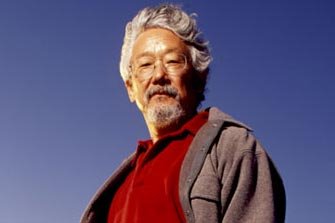
An interview that I conducted with Canadian scientist, environ-mentalist, author and broadcaster David Suzuki has been posted on the web by Science & Spirit, a magazine that explores the relationship between, well, science and, uh, spirit.
Suzuki is a visionary thinker, as well as a fiesty and funny person to boot. I talked with him in his Vancouver BC home as his book/public TV series "The Sacred Balance" was just coming out, so our conversation tended towards discussion of the intersections of modern science and aboriginal/indigenous wisdom, one of his favorite subjects. Click here to read the interview.
One of my favorite Suzuki quotes from our talk: "The native communities up and down the coast here have a clan system, built on cedar, on frogs, on killer whales. They call these things their “relatives.” Well, if you look at the Human Genome Project, to me the exciting thing about completing the human genome is not that we’re going to discover the cure for cancer and all that stuff, but that in the human genome, we find genes identical to genes found in frogs, insects, bacteria, fungi, and trees. What the Human Genome Project does is it confirms what native people have always known: They’re our relatives. And if you look out at the world and you see a world filled with relatives, surely you’ll treat your relatives differently from the way we treat the planet’s inhabitants."
david suzuki
environment
science
09 April 2006
Viva Copper Canyon Press!

The Seattle P-I recently penned a fitting tribute to Port Townsend's Copper Canyon Press, one of the finest poetry publishers in the world. Despite the fact that they only have 3 full-time staffers and are housed in a tiny ex-Army barracks at Fort Clatsop State Park, Copper Canyon Press won both the Pulitzer Prize and the National Book Award in 2005. Jim Harrison, Ted Kooser, M.S. Merwin, Pablo Neruda, Red Pine and Czeslaw Milosz all have books of verse with the press, and they deserve all the praise that is lavished on them.
poetry
"Ding-dong, the fee is dead"

Ron Judd, frisky Bellinghamster and author of the Seattle Times' "Trail Mix" column on all-things-outdoors, has this to say on the demise of Washington State's trail fees
04 April 2006
"Another Roadside Disaster": Tom Robbins on sprawl

I recently came across a hot pink flyer that had been inserted into the Channel Town Press, the lower Skagit Valley's weekly newspaper. It was authored, supposedly, by local scribe and psychic cosmonaut Tom Robbins, and there are just enough hints within the text for me to believe it's true. (La Conner is, BTW, a smallish hamlet in the Skagit Valley where Robbins has lived for decades.)
Read on....

“The Selling Out of La Conner
La Conner is not growing. It’s being grown. Grown artificially and needlessly, without any vision, wisdom or imagination.
Here’s a question for those local residents who support this imposed urbanization. Are you proud that a relaxed rural village that once was something genuinely special; that had character, individuality, historic charm, natural beauty, artistic temperament, community spirit, and yes, soul, is being systematically turned into a replica of downtown Kirkland, just another one of those sterile dime-a-dozen shopping destinations (all tootered-up and puckey-wucked) that dot the coast from White Rock, B.C. to the Mexican border?
Are you proud that you’re being manipulated and played for suckers by predatory developers and their sweethearts in government? Are you proud to meekly surrender a nourishing and authentic quality of life – and that of your neighbors and descendants – so that a handful of entrepreneurs can fatten their wallets at your expense?

Are you proud that your mayor and his cronies appear poised to increase our population by 20 to 50 per cent (think about that the next time you’re stuck in line at the post office) with no regard for the impact that explosion will have on infrastructure, traffic, crime, health, classrooms, privacy, pollution, noise, tradition, and your personal taxes. (In his scholarly book Better Not Bigger, Eben Fodor cites a plethora of facts and figures that demonstrate when small towns act to broaden their tax base their financial problems actually dramatically increase. One result is higher taxes.)
If you believe this kind of suffocating growth is “progress,” we have some Enron shares we’d be happy to sell you.
Save La Conner’s Soul –
Tom Robbins,
secretary/treasurer”
PS. These are photos I took at a Robbins reading of "Villa Incognito" at the UW's Kane Hall a few years back....
tom robbins
Subscribe to:
Posts (Atom)