16 November 2006

Saturated


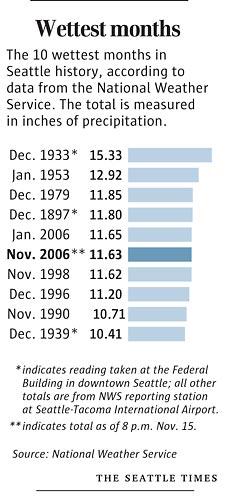
Rainest November ever here in Ish River Country as back-to-back winter storms hammer the Northwet : 11.64 inches fell in Seattle while rivers spilt over their banks, lights went dark and phones fell where the first chair of the season creakily climbed up the ski hill for yet another season. The Hoh River Road suffering a 75 feet long by 25 feet=deep blow outt, North Cascades Highway closed down weeks earlier than normal and the Mount Baker Highway is down to one lane near Maple Falls. The backcountry is reportedly getting hammered too; Mt. Rainier National Park is closed down for the first time in its 107-year history, with untold numbers of bridges, campgrounds, trails and road miles scoured out of existence. It is too soon to know how bad it is elsewhere in the remote corners of Cascadia.


I wonder in particular about the thousands of salmon that are making their annual return to Ish River spawning grounds in these past weeks. With fast-moving water saturated with soil and other suspended particles, the caving in of river banks and scouring of riverbottom gravels, I don't see how these storms can be helping. On the other hand, the fury of the winds and rain are washing a huge bumper crop of trees in to and down rivers, where they will snag and accumulate, building up new in-stream structures that provide excellent habitat for salmon fry. In fact, at the Salmon Summit in Bellingham two weks ago, a lead scientist in the salmon recovery efforts of the Puget Sound basin explained that the lack of quality woody debris in local waterways was one of the foremost limtiing factors in salmonid rehabilitation. So.
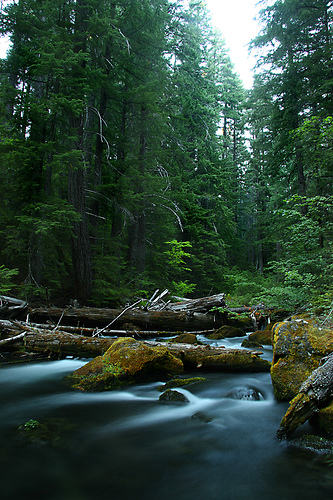

I also tend to suspect that these types of extreme weather events give the landscape a good scrubbing. Not only do they remind us of powerful forces that lie outside of human control, no matter how clever we think ourselves, but I can se how the carving of new river channels, closing of old roads, clean sweep of old detritus and refreshening of water tables, lakes, ponds, marshes and other wetland are all rejuvenating results. Then again, as the influence of Homo sapiens on the plant's climate increases, it is hard to tell when a storm is naturally revitalizing or freakishly destructive. So.

Seattle Times covers the deluge here, and provide the chart below.


14 November 2006

"I feel like one of the great cedars of the North Cascades has fallen"


Harvey Manning, the godfather of Washington's wilderness system and tireless trail bodhisattva, passed away last weekend at the age of 81. Manning's influence as an environmental leader, author and advocate cannot be overstated, and as his friend and former president of the Alpine Lakes Protection Society Rick McGuire succintly put it, "I feel like one of the great cedars of the North Cascades has fallen. It's hard to sum up a man like Harvey. He was a force of nature."

Most people will know Manning as the co-author, along with his longtime hiking partner Ira Spring, of the "100 Hikes" series of trail guides published by The Mountaineers Books. Compared to the bland, unimaginative trail guides of today, his creations were full of personality and passion, wit and wisdom. He never hid the conservationalist agenda present in his prose, and he was unapologetic in his fervent love for all things wild.


Incidentally, my favorite Manning title is not a trail guide at all, but an idiosyncratic travelogue entitled "Walking the Beach to Bellingham." It is a hilarious book in which Manning, well, he walks the beach, all the way from Seattle to Bellingham, following the shore of Puget Sound and sharing local lore, natural history, political diatribes, bad puns and sharp observations all the way. You can all of his offerings here.

The Seattle P-I has a story on Manning's life here and the Washington Trails Association has another one here. While it is hard to read, Peter Potterfield's excellent Manning profile for Backpacker Magazine is reproduced here.

The Alpine Lakes Wilderness, North Cascades National Park, the Issaquah Alps, Mt. Baker Wilderness -- all of these places remain green, rugged and wild in large part because of Manning's zealousness. I hope there are more like him alive and kicking in the Pacific Northwest today. As McGuire puts it, "He left the Cascades a much better place than he found them."


08 November 2006

All Wet

Much of Ish River Country is underwater this week, as record rainfall riding in on the Pineapple Express dumped on the mountains and filled the rivers to overflowing.


Here is a view of the Nooksack River inundating Lynden in northern Whatcom county near the border with BC (photo from the Bellingham Herald).

More to come....


04 November 2006

"Salmon Moon"


Surf
of moonwave,
mist of dawn by the sea.
Mist of long lovely night ending.

The moon steps through the night.
It goes out into the south and west.

Between sparse old shoreland spruce
the moon is a silver wing
in the clouds.

All night
the clouds drift over.
All night, salmon gather—
first of the run.

--Robert Sund, from Poems from Ish River Country

Dedicated to the 120 adult chinooks that still return to their birth gravels in the south fork of the Nooksack River.

Carving by Wayne D.F. Thomas


02 November 2006

Trumpeter Swans return to Skagit


Driving home from work earlier this week, out of Sedro-Wolley and down Cook Road towards I-5, I saw them for the first time: a V of nine Trumpeter swan cruising overhead in the cloud-curdled sky. Today, I saw dozens more in the muddy fields north of Cook.

They are welcome winter visitors here in Ish River Country, arriving in mid-October from their breeding grounds in Alaska. They stand over 6-feet tall and feed in the fallow fields of the Skagit Valley amongst flocks of Tundra swans (which are smaller) and Snow geese. "Birds of Washington" claims an average of 1000-3000 Trumpeters overwinter in the state, from Snohomish County northwards, and local birding listservs are reporting sightings from Seattle to San Juan Island to the Skagit.

These elegant beauties have rebounded from near-extinction in the 1960s, but have been threatened more recently by ingesting lead shot leftover from hunters in Whatcom County and British Columbia. At least 868 have died since 1999. Martha Jordan, a Skagit Valley ornithologist and bird lover, founded the Trumpeter Swan Society and is leading the effort to monitor the health of local flocks and tackle the lead shot problem. She is looking for volunteers to help with swan surveys, and will payfor your gas -- contact her at swanlady@drizzle.com or (425) 787-0258.

Martha is also leading two field seminars focusing on the ecology of Trumpeter swans in February with North Cascades Institute. Learn more and register here.


01 November 2006

Lonely Trails


Are overnight hikers the Pacific Northwest's next endangered species? The Seattle Weekly thinks so. Read why here.

27 October 2006

Panamanian Frog Hotel


A story in the Washington Post that is both heartwarming and heartbreaking: the tale of the golden frogs of El Valle de Anton in Panama. With a deadly fungus tearing through Central American amphibian populations, the golden frog has been sequestered in a run-down backpacker's hotel at the edge of the mountains with hopes that it can wait out the naturally-occuring chytrid fungus. The Hotel Campestre has become a sort of postmodern Noah's Ark and currently has 40 species of endangered frogs and toads shacking up in it. "The volunteers found glass frogs with skin so translucent that their organs are always on full display," explains the Post. "They picked up frogs that look like rocks and eat freshwater crabs, aggressive tree frogs and shy, nocturnal toads."

The hotel's guests are happily mating, and scientists are monitoring their reproduction, waiting for the day when it is considered safe to release them back in to the wild. But Good Samaritan impulses aside, interesting questions arise.

"There's this moral dilemma," one Panamanian biologist said. "Is this evolution? Should we let it run its course? If we do this for frogs, then do we do it some other time for the snakes?"

Also, scientists wonder if "the frogs they are saving in Panama might be the last of their kind? And might those frogs -- those jumping, squirmy delights -- never see the outside world again?"

Should humans play the role of Noah by taking wildlife out of their native habitats and shielding them from the blind course of natural selection? Is our planet becoming so unhospitable to animals, birds and fish that we will eventually have to create virtual habitat in order for them to survive?

Read the rest of the story here.

North Cascadian Larch Magic


"It was another October gold rush in the North Cascade Mountains of Washington, with foliage prospectors at altitudes of 6,000 feet and beyond gazing at their chosen grail: the alpine larch, a slender tree whose velvety needles turn an incandescent yellow-gold come fall." So writes Linda Baker in today's New York Times' Travel section. Great tribute to the amazing larch tree of the North Cascades high country; read it here.


19 October 2006

R.I.P. Hugo, Jellyroll & Raven


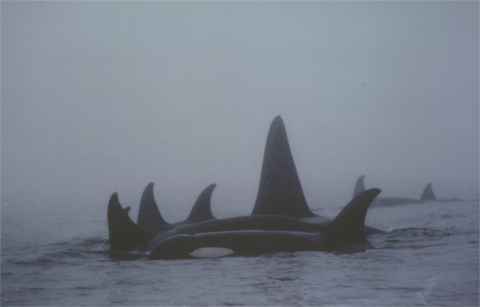
Several Pacific Northwest newspapers reported last week on the disapperance and presumed death of three orca whales from the San Juan Islands pods: Hugo, Jellyroll and Raven have vanished from their usual haunts and hunting grounds. This is a distinct departure from the good news of last spring, when several new orca whalets were discovered, and a terrible turn for the precarious local population. In general, they've been seen as slightly rebounding in numbers, but the mysterious recent disapearances reinforces the reality that Puget Sound's orcas are being pummeled by multiple threats all at once.

What happened to these particular three swimmers? Was it the built-up levels of PCBs biomagnified and stored in their blubber, bestowing upon them the dubious distinction of "most polluted marine mammals in the world"? Or did they starve to death from a lack of salmon, another species not doing so hot in our troubled waters?

"When salmon are plentiful, the whales tend to travel close together," the Seattle P-I reported on Wednesday, "but this year's sightings revealed the whales as spread out, indicating they were foraging and food supplies are short."

The Seattle P-I just published a commendable series on the state of the Puget Sound, written by their crack team of environmental investigators, Robert McClure and Lisa Stiffler. You can read their entire series "Broken Promises" here. Part of the series is a dramatization of the life of one particular Puget Sound orca named "Granny" written by M.L. Lyke. "She has lived long, seen much, some of it best forgotten: Bullets, bombs, nets, babies born dead. She understands the world of orcas. It's always about survival, always about community." You can follow Granny's story here.

Read more about the lost orcas here or here.

Incidentally, while researching the web for orca information, I came across this fascinating movie on YouTube--check it out.


28 September 2006

Last sunset of the summer

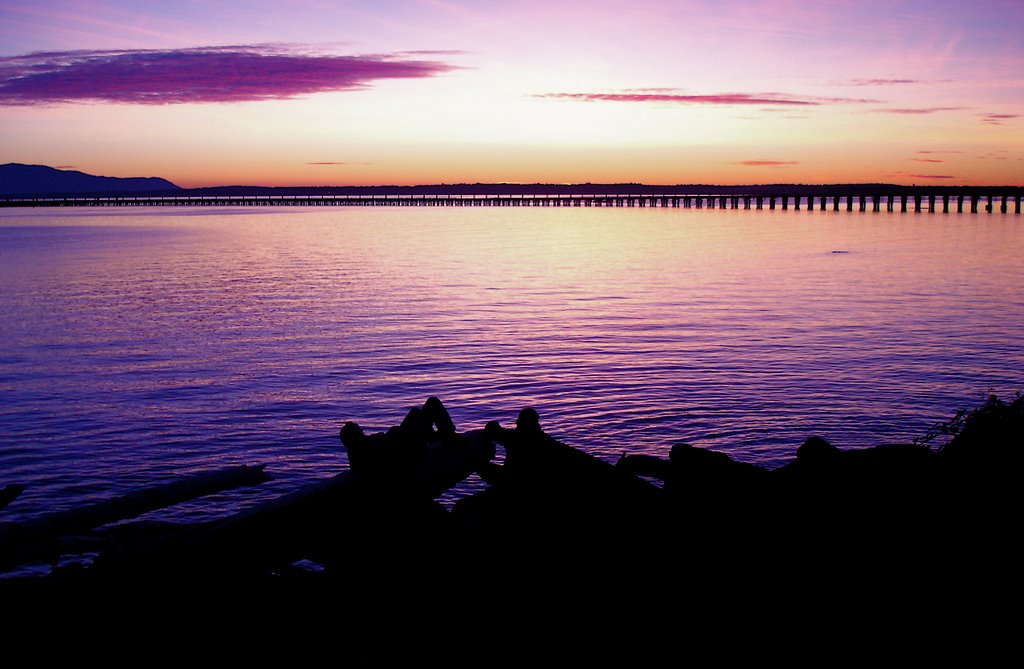
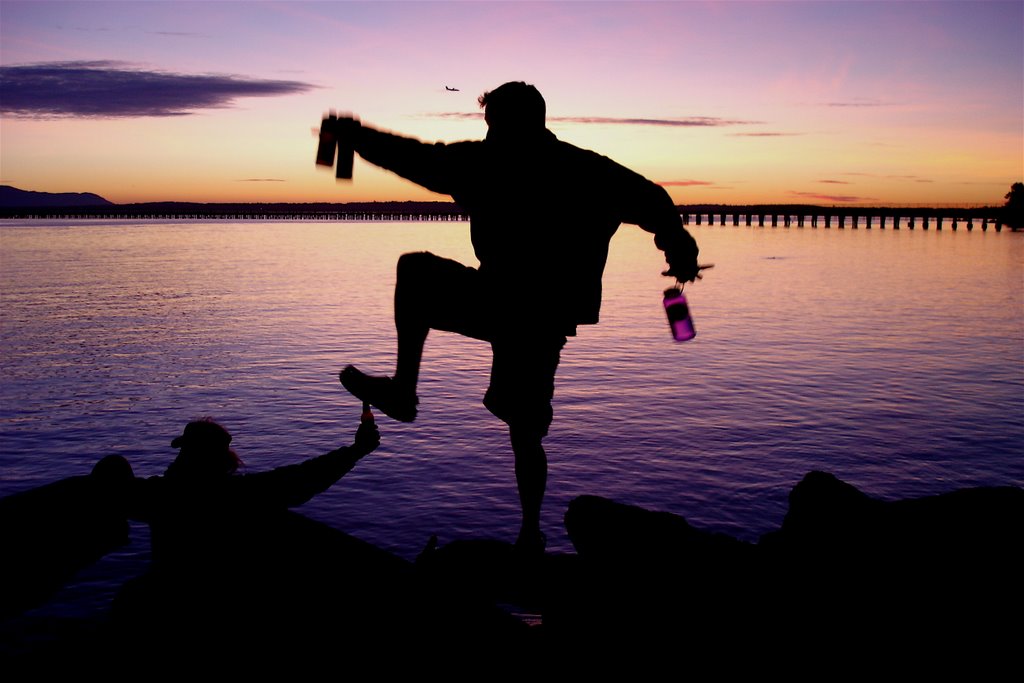
Here's the view from Bellingham Bay, in the far northwestern corner of Washington State, on the Fall Equinox....


22 September 2006

"Messenger"


My work is loving the world.
Here the sunflowers, there the hummingbird--
equal seekers of sweetness.
Here the quickening yeast; there the blue plums.
Here the clam deep in the speckled sand.

Are my boots old? Is my coat torn?
am I no longer young, and still not half-perfect? Let me
keep my mind on what matters,
which is my work,

which is mostly standing still and learning to be
astonished.
The phoebe, the delphinium.
The sheep in the pasture, and the pasture.
Which is mostly rejoicing, since all the ingredients are here,

which is gratitude, to be given a mind and a heart
and these body-clothes,
a mouth with which to give shouts of joy
to the moth and the wren, to the sleepy dug-up clam,
telling them all, over and over, how it is
that we live forever.

--Mary Oliver, from "Thirst"; Beacon Press, 2006.

29 August 2006

Interview with Barry Lopez


The Georgia Review's current issue features an interview I conducted with Oregon writer Barry Lopez, author of the outstanding "Arctic Dreams," "Of Wolves & Men" and several collections of short stories. You can read it on the web here.