18 May 2007

Washington WildWatchCams

I've been over the moon watching watching eagles, owls, herons, bluebirds and an osprey tend to their young in nests throughout Ish River Country this past week via webcams courtesy of the Washington Department of Fish & Wildlife. There are a number of cameras mounted on the edge of bird nests, from which one can witness the daily activities of the aforementioned birds sitting on eggs and/or tending to their freshly-hatched little ones.Normally, these cameras can be pretty boring, but right now is prime time for lots of busy nesting activity, and I find myself leaving the browser windows on my desktop all day, monitoring what is nothing less than an amazing show of new spring life and parental nurturing.
These photos are some highlights from the past couple of days. Watch the show yourself by visiting the WildWatchCams homepage.

31 March 2007

Spring Migrations


Springtime is advancing rapidly here in Ish River country, with Red Currants and Indian Plum in full bloom, bringing in the hummingbirds from the south. The arrival of migrating birds is, to me, the surest sign of the seasonal shifting. My daily commute through the Skagit Valley reveals a few Trumpeter swans still mucking about in the muddy farm fields, but their numbers are diminished, and the snow geese don't seem to be around anymore -- maybe they are somewhere over British Columbia, flying northward to the Aleutian Islands where they nest and raise their young in what must be one cacophonous assembly of life.

This year, I've been loving a new technological advance that is helping me to more fully realize the miracle of bird migration. Several researchers have attached satellite-based receivers to specific species, which is nothing new, but the birds' movements are being tracked via Google Earth, which is. I am a huge fan of Google Earth, and have spent many hours visiting locales all over the planet, from Jackson Hole to Costa Rica to Tibet. I think it an excellent tool to help one get a better sense of place for where they live, and to better visualize the breadth and diversity of the planet's geographies and ecosystems. It gives one a bird's eye view of the land, and let's one explore and better appreciate how things fit together: mountain ranges, valleys, rivers, watersheds, plains, deltas, the patterns of human settlements and the wild, empty places that still exist.

Anyways, I know of three websites where you can download .kmz files, which open in Google Earth, and show the daily movements of migrating birds. Bud Anderson, Ish River's premier hawk guru, and the Falcon Research Group are tracking peregrine falcons of Chile -- you read an overview of the Southern Cross Peregrine Project and download the .kmz files to follow seven specific birds at their website and follow their ongoing discoveries blog..

Another similar project is tracking Bar-tailed godwits as they leave New Zealand and head north through Asia. You can download the .kmz file and follow their daily movements at this USGS website.

If you know of any other similar projects where animals are being tracked via Google Earth, email me and let me know!


18 March 2007

Dark Days in a Dank Place

Ish River Itinerate offers this report from a correspondent up in the north fork of the Nooksack, Mr. Trail Rat. We're reprinting his submitted field report verbatim. Dark days, indeed.
-- the editor


Dark Days in a Dank Place
Police “crack-down,” tragic blaze mar 22nd Annual Legendary
Banked Slalom


by Trail Rat

What should have been a joyous weekend-long festival of snowboarding and celebration in the upper North Fork Valley was, instead, inexplicably dampered by a bungling, overzealous detachment of local law-enforcers and the devastating loss of one of Whatcom County's most unique and historically significant "pioneer-era" structures.

Citing a need to prevent everything from large, unruly parties, open drug use, reckless/drunken driving and snowboard theft, Whatcom County Sheriff Bill Elfo unleashed a small army of several dozen deputies, State Troopers, K-9 units and undercover officers to secure the eastern foothills from droves of raving, out-of-control snowboarders during Banked Slalom
weekend (Feb. 9-11).

Along with issuing 108 traffic citations, these so-called "peace officers" hassled and intimidated scores of innocent pedestrians walking along Mt. Baker highway, crashed through the gate at Mt. Baker Rim (twice!), ticketed a skateboarder and tasered a dog. Scores of locals and visitors alike (including film crews, journalists and professional snowboarders from all over the globe) reported being harassed without probable cause and business owners received complaints of intimidating police behavior from customers
throughout the weekend.

Sadly, even as the hills fairly swarmed with pistol-toting, ticket-happy law men, the Powers That Be could not prevent a tragic, Friday night blaze that
reduced the historic Bourn-Anderson cabin to little more than a pile of smoldering ash by Saturday afternoon.

This legendary (and much-cherished) log cabin, built in the 1930s by local prospector Charlie Anderson with the help of Jerry Bourn, represented Whatcom County's last remaining ties (historically and architecturally) to the historic Mt. Baker Mining District and, ironically, had recently been identified as one of the “Most Endangered Historic Properties” in the state
by the Washington Trust for Historic Preservation.

Jerry Bourn, the colorful, misanthropic "Mountain Man" who occupied the cabin from the time of Charlie Anderson’s death in the 1940s until his own demise (by car accident) in 1980, single-handedly battled the Forest Service for decades to maintain his “squatter's right” to occupy the unpatented mining claim on which the cabin sat.

While losing the cabin deals a devastating blow to the fledgling preservation efforts of our community's rich and illustrious pioneering heritage, it hardly comes as a shock. Despite many calls to better preserve this unique, last-of-its-kind "historic resource" in the years since Mr. Bourn’s passing, the cabin was left to deteriorate -- suffering a “slow but gradual death” at the destructive hands of vandals, punishing mountain snows and a near-criminal lack of restoration funding.

All of which leads one to ponder: is the current post 9-11/Homeland Security trend of accelerated, near-unimpeded law enforcement spending (locally and nationally) actually making our communities any safer? For roughly the same cost of employing a deputy and a trooper for a year, an invaluable historic landmark could have been secured, re-built and properly managed for this (and all future generations) to contemplate, explore and enjoy.

But instead, what do we get? Our history reduced to a pile of scorched beer bottles and the bitter, highly unsavory aftertaste of yet another quasi-fascist
police-action in our mouths. No, folks. That big, roiling mist-cloud blowing down the North Fork isn’t rain (or even bong smoke), its the grim, ever-darkening shadow of authoritarianism blotting out the once wide-open, bluebird skies of our mountainous "frontier".

Even with the Pro Men's Golden Duct Tape now safely back in the hands of a local rider for the first time since the Craig Kelly era (thank you Lucas Debari!), it appears that The Age Of The Mountain Crusties is about to slip away from us forever virtually unmarked and largely unsung. Meanwhile, the Sirens of Fear are blaring, the hounds are baying and good old-fashioned
independence (not to mention personal integrity and social responsibility) are on the run.

Jerry Bourn AND Craig Kelly must be turning in their graves.

04 March 2007

Ish River Itinerate on Flickr


Here's a show from my personal stash of favorite images from in and around Ish River Country. They are posted on FLICKR with some caption information here.

01 February 2007

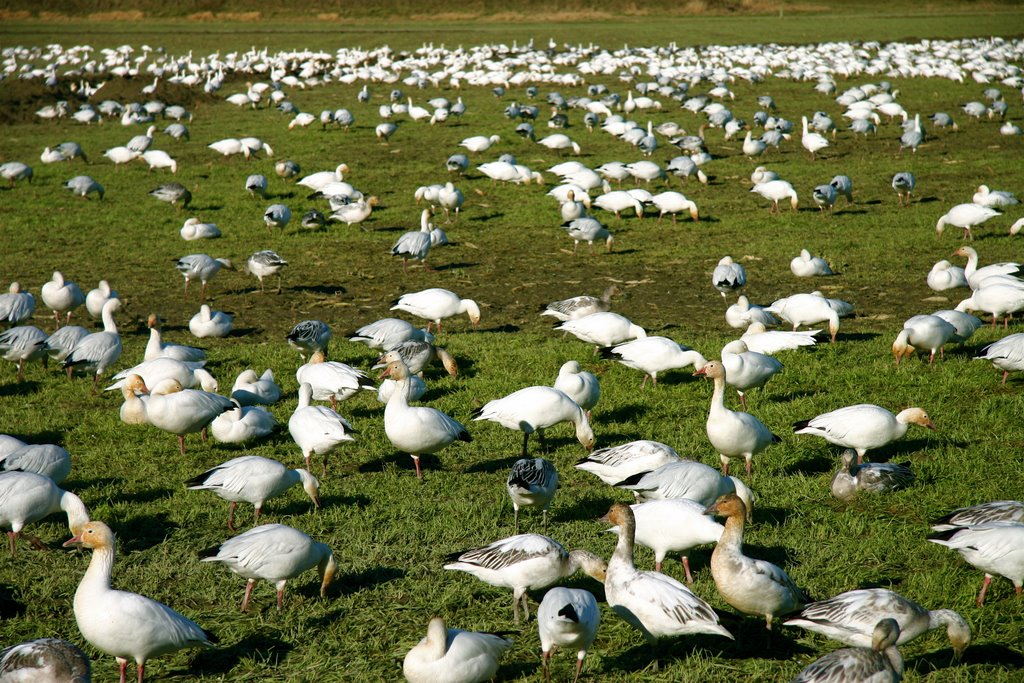
snow geese of the skagit


Spent last saturday peregrinating the Skagit flats, studying raptors and owls and bald eagles with North Cascades Institute and a field scientist-expert guide, David Drummond. We discovered the flock of snow geese, wintering over with us all the way from Wrangell Island, down in southern Skagit county on Fir Island, the wedge of dike-enclosed land riding low between the two mouths of the Skagit River.

I took a series of up close and personal photos, and have posted a selection over at Flickr -- you can see them by clicking here. I recommend viewing the excursion in "view as slideshow" mode.

31 January 2007

Local orcas head south


Why are Ish River's orcas traveling all the way to central California this winter? Dozens orcas from Puget Sound have been spotted recently in Half Moon Bay and around the Farallon Islands. Scientists have identified them as belonging to the "K" and "L" pods, and the obvious answer as to why they are so far out of their historic range has to do with their appetites: salmon are more plentiful in the Sacramento and San Joaquin River systems than they are in the ailing Puget Sound. "They are extending that far to try to keep everybody fed," said David Bain, research director for Global Research and Rescue in Seattle. "It's a bad thing, in that whales ought to be able to make a living locally."

Spotting them so far south "extends their range 1,000 miles," according to one researcher, which brings to mind questions about the lengths to which animal species can adapt their behavior in response to human-caused disruptions in the ecosystem and about the long, winding, mysterious pathways of evolution.

By the way, orcas can travel at 3 miles per hour, and cover 75 miles a day. Thus, it would take them something like 10 days to two weeks to move from Ish River country to San Franciso.

Informative articles in the San Francisco Gate here and Seattle Times here


21 January 2007

Skagit Sunday Sund


Don't cry geese,
in this floating world
it's the same anywhere you go.

--Issa (1763-1827), translated by Ish River poet laureate Robert Sund.

photo from "planetphotoman."

16 January 2007

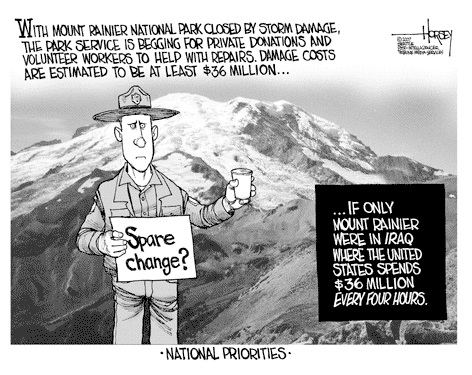
Spare Change?


--By Pultizer-winning cartoonist David Horsey at the Seattle P-I.

11 January 2007

Mount Rainier Gutted (or, The Restoration of America's National Parks)


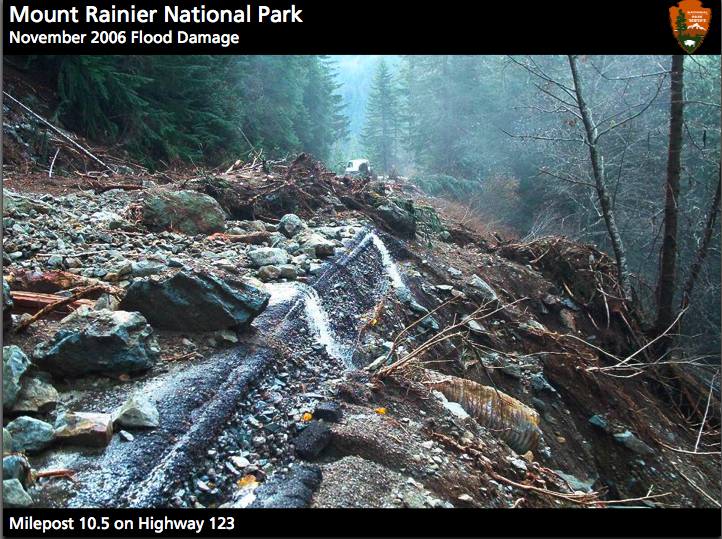
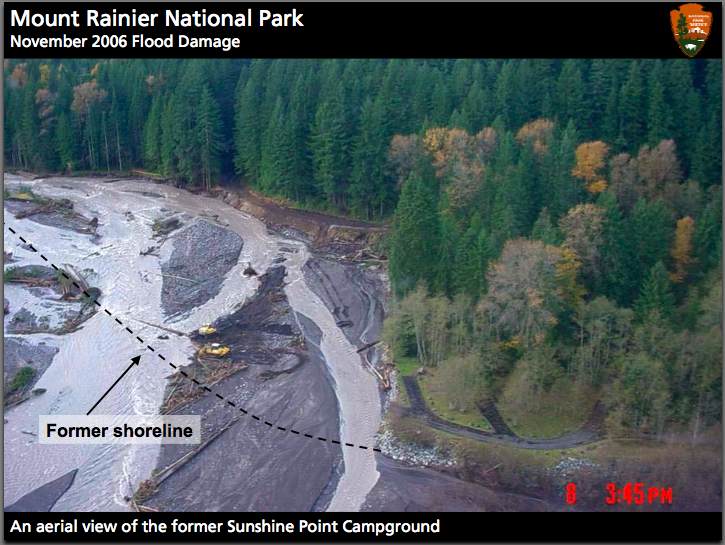
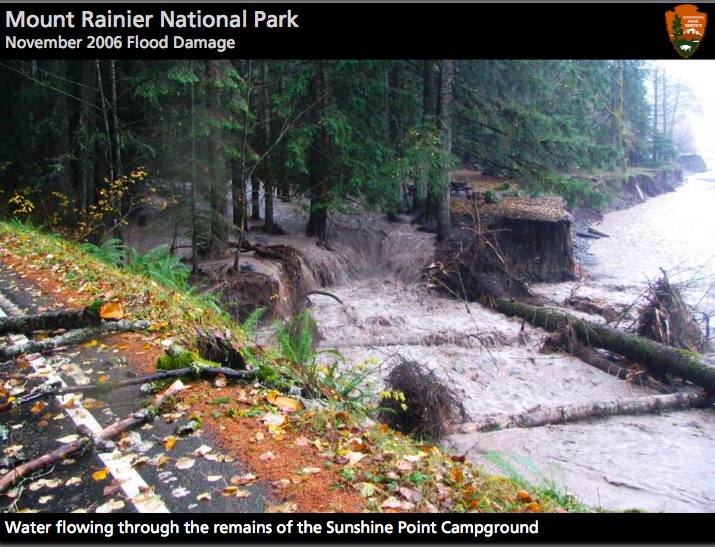
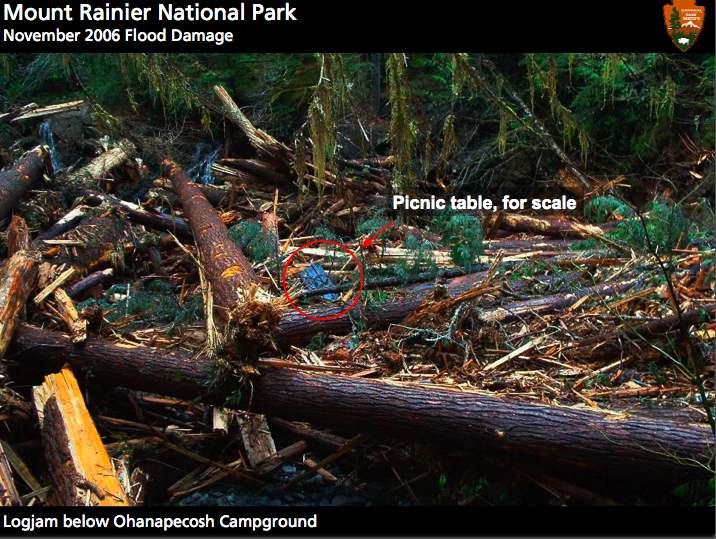
Well, the mountain itself is doing fine, but most of the human paraphernalia surrounding the mighty volcano -- roads, visitor centers, bridges, campgrounds, trails -- have been utterly demolished in the floods of November. For the first time in its' 108 year history, the national park is closed. The destruction is awe-inspiring, and I recommend you check out the web slideshow at the park's website to witness the raw, unforgiving power of Mother Nature.


The slideshow is here -- it takes a second to load, but will drop your jaw -- or you can enter this page for the full menu of videos, galleries and other depictions of destruction.


The demolition of Mt. Rainier National Park's assets presents a perfect opportunity to rally behind a campaign to provide more funding for our national parks. This is a huge passion of mine -- to raise park budgets instead of diminishing them by a thousand tiny cuts, to invest time, energy and federal dollars in to repairing and updating park facilities, which are in a woeful state from decades of benign neglect. I believe that our national parks (and other public lands) are this country's true treasure. Our protection of them -- North Cascades, Canyonlands, Yosemite, Glacier, the Grand Canyon, Rocky Mountain -- is our gift to the rest of the world, those of us among the living as well as for the generations to come.

Mt. Rainier National Park could serve as the poster child for our park's desperate need for investment. It is a well-loved, heavily visited park and nobody is going to argue against its' repair. Its' catastrophic destruction serves to dramatize our parks' plight, though honestly, most probIems are more invisible to the casual visitor -- leaking septic tanks, crumbling trails, air pollution and less and less staff to do behind-the-scenes work.

I hope that in the next presidential election there will be a candidate (calling Al Gore!) that takes on stewardship of our public lands as an issue and makes their restoration a plank in their campaign. It would be great to have this issue brought out in to the limelight so that, at the very least, awareness of the problem would be heightened.

I know, I know -- the current administration has messed up everything damned thing it has touched so severely that national parks will seem to most to be way down on the list of priorities. But a campaign to protect and restore our parks could be included in a more general campaign to incorporate sustainability in to the federal government and its'/our assets. Think of it -- national parks could be remade in to living laboratories of new sustainable technologies, a place where the public could experience "green living" and see how "normal" it can be, and a place for experimentation and study. I see no reason why the parks couldn't go off the grid and be energy sustainable on their own -- solar power at Zion, geothermal at Yellowstone, wave power at Olympic -- not too mention composting toilets, the removal of asphalt, mass transit for employees and visitors and LEED-certified structures.

And let's not forget that the root of the term "conservative," which Bush, Kempthorne & Co. claim adherence to, is "conserve," which my dictionary defines as to "protect something from harm or destruction" and to "prevent the wasteful or harmful overuse."

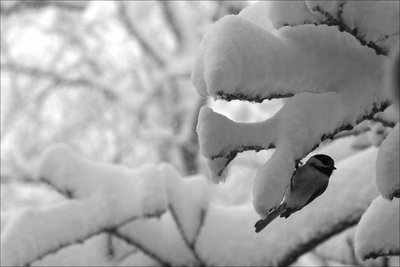
Could We The People make the restoration and stewardship of our public lands and parks a patriotic cause? Or are my political and populist dreams, like the photo below, a dead end?


08 January 2007

Bald Eagles on the Skagit


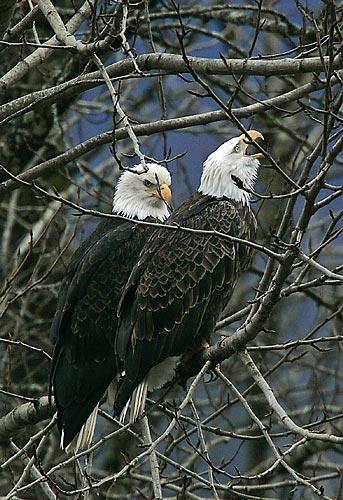
I spent all of last Saturday (1/6) watching bald eagles on the Skagit River with a North Cascades Institute field seminar led by local eagle guru Libby Mills -- we concentrated our search between Rockport and Marblemount on Highway 20 and had great success throughout the day. (We were lucky enough to not only stay dry, but also get some rare sunshine.) Dozens of eagles were easily viewable from the highway at the Rockport turn off, and our class found a prime viewing spot on the opposite side of the river where we stopped counting white heads after 100! One solitary big-leaf maple tree on the river's edge held between 30-40 eagles. Both adults and immatures were actively feeding on chum salmon carcasses that were washed-up on gravel bars. Our group also saw large steelhead jumping out of the water near the Marblemount hatchery (and the attendant fishermen, on shore and in drift boats), though the eagles weren't hunting them, probably because the chum carcasses were so plentiful. Libby reported seeing over 400 bald eagles (!!!) from one vantage point on the Skagit earlier in the week; she thinks she must've got lucky by showing up in the middle of a migration coming down from BC.


North Cascades Institute, where I work, has Eagle Watcher volunteers stationed up and down Highway 20 every weekend in to early February. They are out there rain or shine with spotting scopes, field guides, info on good viewing sites and lots of enthusiasm and good cheer. If you want to learn when and where the Eagle Watchers are located, please visit their webpage. There you can also find out info about the Bald Eagle Interpretive Center in Rockport, the Bald Eagle Festival in Concrete and more.


My favorite part of the outing came at the end of the day, when our group watched the eagles fly away from the riverbanks and disappear into the snowy mists on Sauk Mountain as they headed to their night roosts. Wish I would had a zoom lens to get better photos...


22 December 2006

nearer to Spring


I heard a bird sing
In the dark of December
A magical thing
And sweet to remember.

'We are nearer to Spring
Than we were in September,'
I heard a bird sing
In the dark of December.


- Oliver Herford, "I Heard a Bird Sing"

Setting the buds


'We provide consolations to get through winter—vitamin D supplements, smoked salmon, candles, Christmas lights, cassoulet, oatmeal, velvet, Irish whiskey with hot water and lemon. But for all the comforts we give ourselves, for all the heating and bright lighting, we're still basically creatures who have more in common with the furry beings of the world, and even the leafy beings of the world, than we think. Our bodies are inextricably linked to seasonal cycles.

I wonder if there was a time in human history when sluggishness in winter was good for survival? Should we be using this semihibernation as a time of renewal? Should we be, figuratively, setting the buds for spring leaves and flowers?"

--Constance Casey, from "Sleepy Solstice: Why plants and animals hibernate in winter." Read the entire article on Slate.