Showing posts with label poetry. Show all posts

01 June 2012

Gary Snyder on Ish River Country

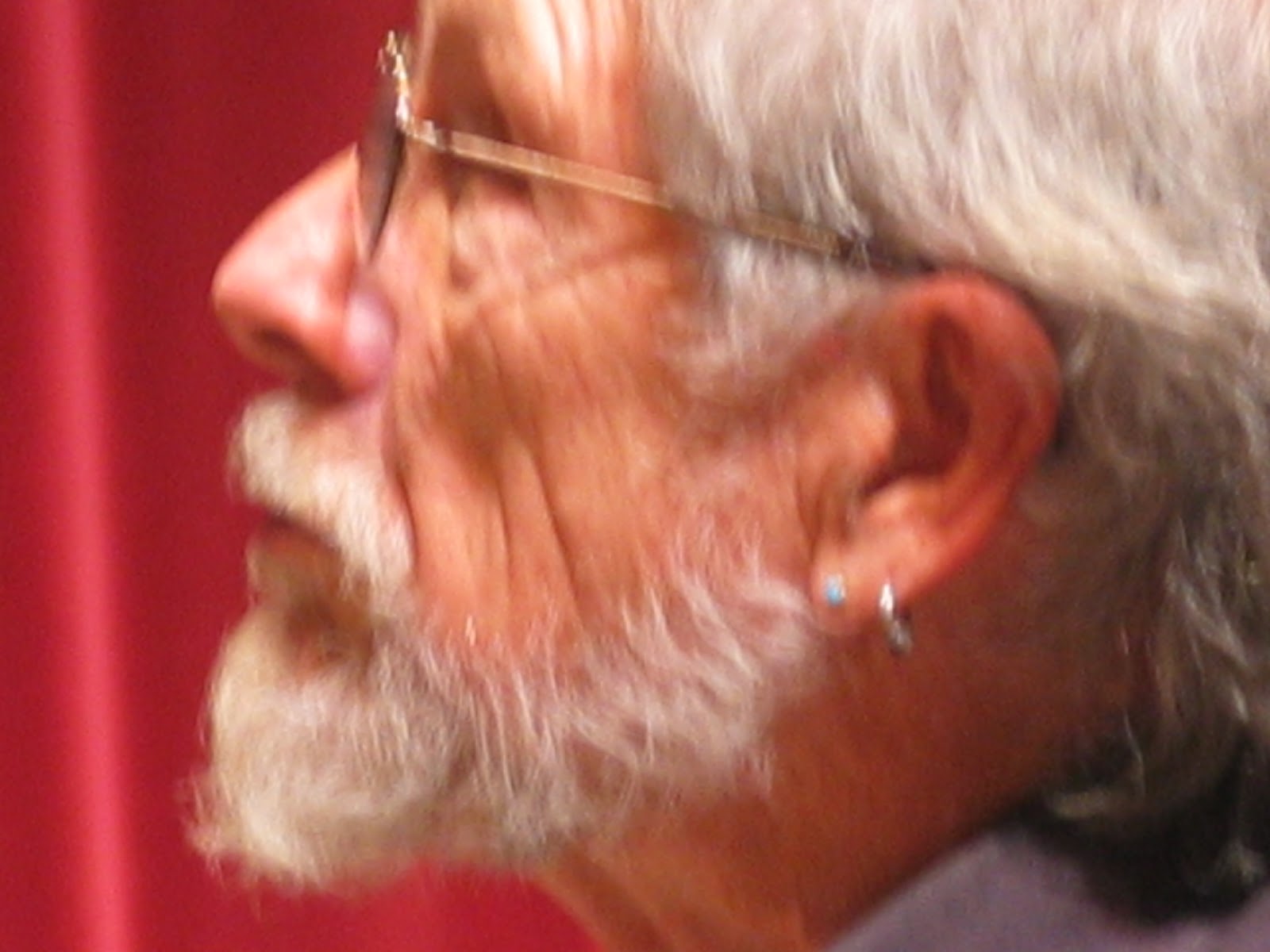
Gary Snyder at Bellingham High School, 2004

"In the fall of 2004, I heard Gary Snyder read from his most recent collection of poems, Danger on Peaks.  In a calm, steady tone, Snyder delivered his selection to what is likely the most attentive audience that the Bellingham High School auditorium has ever boasted. His poetry is renowned for its ability to arrest and articulate specific moments in nature.  The simplicity and clarity of Snyder’s rendering almost masks the careful rhythm, which implicitly structures his voice.  His work blends respect for the natural world with Zen Buddhist thought, achieving truly innovative modes of telling.

Snyder was born in San Francisco and grew up in the Pacific Northwest.  Over the years he has undertaken many endeavors:  he was a logger in his youth, he studied anthropology at Reed College, then Chinese language at Berkeley, and Buddhism while living in Japan.  In the late 1950s, he was influential in the Beat Generation/San Francisco Movements (along with Ginsberg and Kerouac).  Snyder is now the critically acclaimed author of sixteen collections of poetry and prose and was awarded numerous literary prizes, including a Guggenheim fellowship (1968) and the Pulitzer Prize (1975).  Until recently, he taught Creative Writing and literature as a professor at UC-Davis.

Snyder and I met on the morning following his reading in the lobby of the Fairhaven Inn in Bellingham....

Anne Greenfield:  You mention Bellingham in Mountains and Rivers Without End and, more recently, in Danger on Peaks.  How did you come to know Bellingham and how has this relationship changed over time?

Gary Snyder:  I was raised on a little dairy farm just north of Seattle, through the thirties and up early into WWII.  The country between Seattle and the Canadian border was mostly dairy farming or logging in those days. We had a little dairy farm, so in our spare time when we wanted to go out and travel and look at things we would go look at dairy farms.  That would bring us all the way up here once or twice to Bellingham, Sedro-Woolley, up the Skagit Valley, Mount Vernon, and back down.  That’s my first memory of Bellingham.

Later, from the age of fifteen on, I started mountaineering.  And one of those summers (I think 1946 or 1947) I came up with some Mazamas (a climbing group from Portland, Oregon) to climb Mount Baker. And I worked in the forest service, up the Skagit, in the summers of 1952 and 1953, when it was still the Mt. Baker National forest.  I often came to Bellingham with friends, particularly one friend who I’m going to meet for dinner tonight: Jack Francis, who’s lived in Bellingham all these years. I came through here with Alan Ginsberg in 1966 on my way to British Columbia.

So, Bellingham has been in my consciousness as part of Ish Country (the Puget Sound region) and the culture of Maritime Northwest Pacific.

AG:  Speaking of sense of place, much of your work is grounded in and speaks to location and specific places.  In fact, your recent collection takes up the 1980 blast at Mount St. Helens.  Have the recent eruptions there triggered anything new for you?

GS:  Well more thoughts of the same. Pacific Rim Circle of fire:  the chain of volcanic activity down the west coast as far south as Mount Lassen, actually as far south as Mono Lake.  The actual instability of the earth’s crust and that fact that every volcano that exists on the west coast is more apt to erupt again than any place that doesn’t exist as a volcano already.  Mt. St. Helens – if you look at its history- which I did – erupts every few centuries. It has been erupting every few centuries for some time.  Mt. Rainier is quite capable of doing a major eruption at any time.  So this is part of our life here. Except, being very short lived creatures, human beings, and being new to the region – that is to say the present American population has only been here for a hundred and fifty years – we don’t have much consciousness of it. I am exploring what that consciousness would tell us. So, having some recent events at Mt. St. Helens is hardly surprising.  It’s part of the story and the story goes on.  Who knows what comes next?

AG: Danger on Peaks has been deemed your “most personal collection yet.”  To what degree do you see your poems as autobiographical?

GS:  I’ve never written autobiographical poetry as such. On the other hand, whatever one does in poetry has to be grounded in deep personal experience.  But personal experience is not necessarily autobiographical experience because we are all vertebrate mammals.  And we live in very much the same body and the very same mind. To be grounded in your body is not autobiographical.  And to be aware of the world is our mutual heritage, but not everybody sees it immediately and clearly.  Which is something that my own artistic inclination, plus my Buddhist practice, pushes me towards: mindfulness in the present moment."


From "Grasping the Natural: A Conversation with Gary Snyder" by Anne Greenfield, published in 2004 in the Bellingham Review. Photo copyright Christian Martin.

22 May 2012

Notes from Disappering Lake: The River Journals of Robert Sund


Robert Sund is our bard of the Skagit River, a singer of songs celebrating skunk cabbage, frogs, muddy water, ducks, and the rising tide.

In the summer of 1973, the poet — who studied under Theodore Roetke at the University of Washington in the early 1950s — built a small dwelling on the pilings of a former fisherman’s shed in the estuary of the North Fork of the Skagit River. Access was only by boat and though his hermitage was only a short paddle from La Conner and downstream from the active artists’ colony at Fishtown, he felt worlds away, “far, far back,” from modern society.

This remove gave Sund time and space to closely observe the rhythms of the natural world, as well as the fluctuations of his own thoughts and emotions, and he recorded these impressions in a series of thin, 26-page notebooks. The tidal marsh surrounding his shack, formed where the glacier-fed Skagit mixed with the saltwater of Puget Sound, provided him with endless inspiration for more than a decade of on-again, off-again residency.

“Out on the river you know you are in the midst of a great creation,” he wrote. “You see the old work and the new work side by side: the ancient migration routes of all the birds, and the slow building of silt and soil in the estuary.”

The choicest tidbits from Sund’s 75-plus journals have been extracted and lightly edited to produce a new volume of work from the well-loved poet, who passed away in 2001. Assembled by Sund's close friends Tim McNulty and Glenn Hughes, Notes from Disappearing Lake: The River Journals of Robert Sund presents poem-like journal entries documenting life in the Skagit River estuary alongside spiritual insights, weather reports, and pithy celebrations of friendship and community.

“Robert was obviously not there to advise us,” explains McNulty, “but he was definitely looking over our shoulder as we worked on this project. We excerpted material that was pretty much intact and didn’t need to do much editing. Robert’s voice was rough and authentic and we wanted to keep it that way. Several friends have read these pieces and said, ‘This is like spending time with Robert again.' "

July, 1973
Snipe walking through the
  flowers & grasses
picking worms & bugs out of
    the mud —
Wren on the front porch
  tiny feet
  tick tick.
Robin, swallow
crow, seagull, heron
goldfinch, duck
blackbird . . .
Who needs a radio?
Song at morning
song at evening
and all day long ...
   This is the real news:
    Local, regional, & world-wide.

Though he departed more than a decade ago, Sund’s unique voice, as expressed through his poems, painting, and calligraphy, has risen in repute since the 2004 publication of Poems from Ish River Country by prestigious publisher Shoemaker & Hoard, home of Gary Snyder, Robert Hass, and Wendell Berry. The Museum of Northwest Art’s successful Fishtown and the Skagit River exhibit in 2010 only heightened interest in the unique countercultural confluence of art, poetry, and spirituality that flourished in the Lower Skagit in the 1970s and '80s.
The recent attention paid to to this now-gone locality contrasts the original inhabitants’ desire to be left alone, hiding out in the marsh grasses where they could be free to pursue their alternative lifestyles.


“(The) burgeoning community (of Fishtown) reflected the larger national impulse towards going back to the land, living simply, and disengaging from chaotic political and social events,” Kathleen Moles writes in Fishtown and the Skagit River, the catalog for the MONA exhibit.

Sund had a deep interest in Chinese literature of the Tang and Sung dynasties — as many drawn to Fishtown did — and his shack provided him a private place to live like the hermit poets he read at night by lantern light. The seclusion, hardships and exposure to the raw elements of storms, tides and bird migrations were a forge for his poetic aspirations.

“A river mouth, in and of itself, exerts an influence on human consciousness that becomes manifest in music, literature, and art,” points out Skagit Valley novelist Tom Robbins in an essay in the MONA catalog.

Sund’s journals contained unvarnished etchings of that Skagit-flavored manifestation, and editors McNulty and Hughes’ work to unearth new material from their friend also revealed insights in to the poet’s methods.

“Robert’s journals held his day-to-day notations; they’re perceptive, unique, sometimes dazzling, and of course poetic,” McNulty explains. “His observations offer keen insights into nature, record subtle personal reflections, and explore the experience of solitude in a wild, natural landscape. At the same time they're often happy and joyful. The journals capture those aspects of Robert’s process, personality, and aesthetic in an immediate way. Chip and I had a great time exploring the journals and delighting one another with new discoveries.”


April 24, 1977   4 A.M.
In the excited mind
          words fly.
The night is still, the water still ––
          & suddenly, in the mind
(as on the night river
          a beaver
breaks the silence)
the first ripple of a poem
swims almost invisible by the river bank.
Blades of grass standing in the river
          feel the waves rise and
                    pass through them.

McNulty further says, “I see a marked contrast between the experience of Robert’s journals and the way we’ve become so locked into gadgets and digital media. The idea of Thoreau-like experiences, of being alone in stunningly beautiful landscape and following the mind’s drift on a daily basis…it can’t hurt.”

In light of this posthumous collection of Sund's work, words he once wrote seem prophetic:

Maybe exalted gestures will be
            retrieved in our time.
Maybe our grandchildren will go through
            our trunks and boxes
                  and be amazed.


Poems are copyright 2012 Robert Sund Poet’s House. Top photo: Erik Ambjor; middle: Paul Hansen, untitled (Fishtown landscape); bottom: Christian Martin

25 August 2011

Slough, Decay, and the Odor of Soil

Log decomposition research site, Blue River drainage, Oregon Cascades
By Bill Yake


Trunks, once poised and upright, collapse toward
a two-century graduation into beetle and vapor,
moss, conk, and seed bed -- their boles intermittently
chiseled by woodpeckers uncoiling their barbed tongues
and probing grub-etched galleries within. Hibernacula.
Loosened bark. Sap and heartwood riddled with crawlways
where ants stalk wood-mining fungi, where inexorable
ant-infesting mycelia reciprocate. The odor of must,
cedar disintegrating through pungency to pulp and oil.
The plush, ripe scent of continuous integration.
What seemed solid, stains and softens decade by decade,
to be torn apart by bears after ants: the flavor
on their tongues that of dull sparks. All is relentlessly
hollowed, grain by grain, cell by cell, into sponge and grub
dust, salamander refuge, slug haven, frog shelter, and moss
-- all deepening to opulent, pre-ultimate, humus and duff.

17 October 2008

Flyaway


(Winter in town)
October 13, 1976

(1)
Before the bar closes
I stumble up the hill alone.
The whole town is asleep.

Geese crying in the night sky
wake me out of my drunkenness
into the ancient pathway
given to us
before we had minds.

I am the brother of geese
On my bare arms
long ago
there were feathers.

(2)
Fly at night,
dark sky under your wings.
Sing with your brothers
and
fear no hunter.

Let me hear
over the sea of feathers
that song
carried on in the night,

wave after wave
rising out of the silence, going on--

same song
same silence
as I rise into the sky,
this white feather glowing in my mouth.

-- Robert Sund, La Conner